Categories
open content

The (Australian) Govt 2.0 Taskforce – introduction and initial thoughts

Well the cat is out of the bag and I’m one of the fifteen members of the Government 2.0 Taskforce! And I’m excited by the possibilities.

Unfortunately I couldn’t make it down to Canberra for the launch at Publicsphere2 but I “watched it live on Twitter“.

So what is the Taskforce doing?

Its work falls into two streams. The first relates to increasing the openness of government through making public sector information more widely available to promote transparency, innovation and value adding to government information.

The second stream is concerned with encouraging online engagement with the aim of drawing in the information, knowledge, perspectives, resources and even, where possible, the active collaboration of anyone wishing to contribute to public life.

Importantly, the Taskforce will not just provide advice. It will be able to fund initiatives and incentives which may achieve or demonstrate how to accomplish government 2.0 objectives.

As regular readers know I work in the soft part of government – a part that most people probably wouldn’t even consider as ‘government’. That has its pros and cons.

On the upside it has meant that the government funded cultural sector – libraries especially – have become pretty adept at sharing data and making it available in standardised formats. Our very own National Library of Australia is one of the world leaders in fact. Museums tend to lag – our ‘collections’ of data are far less standardised and are by nature less ‘collaborative’ and more ‘competitive’.

It doesn’t help that we’re encouraged to be ‘competitive’ and find new ways of ‘generating income’ beyond getting people into our buildings. This means we have gift shops, cafes as revenue generators, but also publishing divisions where we look for revenue generation in the data (content) we hold which, until recently, has meant locking it down – yes, even the public domain stuff. We’re only just realising that opening up our data also opens up a blue ocean (and the world doesn’t end).

My team’s recent work with cross-government data (which you will see much more of shortly) has been fascinating and heartbreaking at the same time. Fascinating in that it has revealed that there is an enormous amount of locked up, devalued data out there; but heartbreaking in that its liberation, or even value creation, is prevented by a combination of unsupported legacy systems, an unholy alliance of Copyright and ‘privacy’ concerns, and just a lack of ‘policy alignment’ and resources – the “oh, that’s not our core business so we’ll charge you cost recovery on giving you access to that” problem.

Also, we’ve quickly realised that you are often working with something akin to 6 different interlocking jigsaw puzzles, each missing 20% of the most crucial bits. To provide a useful picture of a location (if you want to deliver mobile services), a period in time (for historical comparisons and trends), or a subject matter – often requires data from multiple agencies in different spheres of government (in Australia – local, state, federal) and that if one of these refuses then the whole is let down greatly (or made meaningless). This is what impresses me so much about Adrian Holovaty’s work with Everyblock – that Everyblock beautifully hides all the difficult, unkempt, manually wrangled datasets that lie beneath it; or Open Australia and MySociety’s original TheyWorkForYou.

We’ve also learnt that raw data is useful to other developers but that whilst projects are still measured in terms of impact on citizens (of whom developers are only a small subset), government projects will continue to be all about the presentation layer and not the release of the actual data behind it. This is relatively easily remedied – do both is probably the logical way forward.

The very recent Stimulus Projects Map on the NSW Government portal that now shows the locations of projects on a map could have easily also released the KML data as an optional download. The project’s success then could be measured by the use of the Stimulus Map on the original site as well as any third party uses of the data too.

New models for measurement and reporting is something we’ve been thinking a lot about now that part of our photographic collection is also on Flickr as well as on our own site – and it gets roughly 20x the usage on Flickr. Does government – our funders – value that as much as us putting it on our own website? what about other citizens and stakeholders (Wikimedia Australia’s Liam Wyatt has an interesting things to say on this)?

Likewise, Joshua Gans criticism of the NSW Baby Names Explorer that my team worked on is entirely justified – “why not release the data?”. Indeed. If we had owned the data we would have . . . we initially had to scrape it form its source to build the prototype! As I wrote in an email relayed to Joshua, the project was about offering an alternative visualisation solution than releasing the actual dataset. Building an alternative visualisation was intended to provide better access to a few single use cases of personalised trend data (“how are the names I am thinking of calling my child trending?”). These were the kinds of questions that were left unanswered on the Births Deaths and Marriages annual league tables, and it was hoped that a new way of looking at the same data might inspire Births Deaths and Marriages to free up the raw data to others – making services for prospective parents isn’t anywhere near their core business. I say ‘hoped’ because of the plethora of roadblocks that had to be navigated even to get a (inside government) third party visualisation of births data online.

So, dear readers, there’s going to be a bit of a forking going on this blog shortly.

I expect that most of my ‘open data’ and ‘social media and government’ posts will end up over at the Taskforce blog – so you might want to grab the RSS if you are interested – whilst the volume of posts here on Fresh & New may decrease as a temporary consequence.

Anyway I’m really looking forward to working on the Taskforce over the coming months and if regular readers have something to contribute then please get in touch.

Categories
open content

1000th Tyrrell image in the Commons (1265 released in total)

Bayswater Road, Darlinghurst
(Bayswater Rd, Darlinghurst, circa 1900)


View Larger Map
(Same location today-ish)

Today we released 24 more images into our pool in the Commons on Flickr. That wouldn’t be such a milestone – we release more each week – but we’ve finally released the 1000th image from the Tyrrell photographic collection.

We’ve now got 1,265 of our images out there in total and we’re up to 1 million views since April 2008 – that’s views of photographs that either weren’t available at all or received what we now understand to have been meagre exposure via our website and Picture Australia. (We thought 31,000 views a year of the 260 odd images we had was pretty good previously!)

We’ve been uploading a bunch of other collections and here’s one of my recent favourites from the Phillips collection – it is a bit creepy and I expect/hope it’ll be remixed into some great new configurations.

Portrait of a boy wearing a mask holding a rifle

(Portrait of a boy wearing a mask holding a rifle, circa 1900)

And of course you can still buy our ‘print on demand’ book of the first year of our Commons photographs.

Categories
Social media

Twitter information for your users – good practice from Mosman Municipal Council

Mosman Council has been doing some great stuff with social media and today Laurel Papworth pointed out their ‘Twitter policy’ that is on their website. They are one of the exemplars of local government social media in Australia – despite being a local government area with a higher-than-average older demographic.

Their information page about the Council’s use of Twitter clearly sets out

– who is tweeting on behalf of the Council (the web team based at the Library)
– why they are doing it
– their reply policy
– how to stop them following you

The clarity here is excellent and a model to base your own institution’s Twitter information page on. I am also impressed that they have experimented and been open about the difference between Twitter communication and more ‘traditional’ forms of contacting Council – this ‘evolutionary’ approach is to be commended.

Categories
Search

Fiddling with Wolfram Alpha

Well, Wolfram Alpha is another nail in the coffin of the value of ‘raw data’ on the internet. And another reason why museums (and everyone else) need to emphasise interpretation, value add, and the ‘experience’ (Max Anderson’s ‘the visceral’). The raw materials will increasingly be free, easy to find, and ready for recombination and building upon. (Another reason why if you are not seriously cataloguing, documenting and digitising you are going to become invisible)

I’m impressed with my initial fiddling around.

Once upon a time you would have found it best to visit the Sydney Observatory to find out where Beta Centauri is in the sky. They would have given you a sky chart – which you can now download monthly from our site with accompanying podcast, or buy the annual Sky Guide book.

Of course, you’ll still find the Observatory a great place for a nerdy date or to get a go on the big telescope, and savour the experience of the historic building and unique location.

Now for the sky and factual data I can just go to Wolfram Alpha and do this search. Notice it has given the result relative to my geographical position and the time in my location. Equally impressive is the ability to see the sources used to generate the information (critical in establishing trust), and the ability to download the result as a PDF.

Now go and try it with people, places and things . . . .

You’ve probably noticed Google has also done some nifty new enhancements to their search.

Here’s the Wonder Wheel

And the Timeline

Categories
Conferences and event reports MW2009

MW2009 Clouds, Switches, APIs, Geolocation and Galleries – a shoddy summary

(Disclaimer – this is a rushed post cobbled together from equally rushed notes!)

Like most years, this year’s Museums and the Web (MW2009) was all about the people. Catching up with people, putting faces to names, and having heated discussions in a revolving restaurant atop the conference venue in Indianapolis. The value of face to face is more the case for people travelling from outside the USA – for most of us it is the only chance to catch up with many people.

Indianapolis is a flat city surrounded by endless corn fields which accounts for the injection of corn syrup into every conceivable food item. No one seems to walk preferring four wheels to two legs – making for a rather desolate downtown and a highly focussed conference event with few outside distractions.

The pre-conference day was full of workshops. I delivered two – one with Dr Angelina Russo on planning social media, and the other and exhausting and hopefully exhaustive examination and problematising of traditional web metrics and social media evaluation. With that out of the way I settled back and took in the rest of the conference.

MW2009 opened with a great keynote from Maxwell Anderson, director of the Indianapolis Museum of Art. Max’s address can be watched in full (courtesy of the IMA’s new art video site – Art Babble) and is packed with some great moments – here’s a museum director who gets the promise of the web and digital and isn’t caught up in the typical physical vs virtual dichotomy. With Rob Stein’s team at the IMA the museum has been able to test and experiment with a far more participatory and open way of working while they (still) work out how to bring the best changes into the galleries as well.

After the opening keynote it was into split sessions. Rather than cover everything I saw I’ll zero in on the key things I took away cribbed straight from my notes. I’ve left a fair bit out and so make sure you head over to Archimuse and digest the papers.

Using the cloud

In the session on cloud computing Charles Moad, one of the IMA developers, delved deep into the practicalities of using Amazon Web Services for hosting web applications. His paper is well worth a read and everyone in the audience was stunned by the efficiencies, flexibility (suddenly extra load? just start up another instance of your virtual servers!), and incredibly low cost of the AWS proposition. I’m sure MW2010 will have a lot of reports of other institutions using cloud hosting and applications.

Following Charles, Dan Zombonini from Box UK who works with, but isn’t in the museum sector showed off the second public iteration of Hoard.it. Last year Hoard.it caused a kerfuffle by screen scraping collection records from various museum collections without asking. This year Dan provoked by asking what the real value of efforts like the multimillion Euro project Europeana is? Dan reckons that museums should focus on being a service provider – echoing some of what Max Anderson had said in the keynote. According to Dan, museums have a lot to offer in terms of “expertise, additional media, physical space, reputation & trust, audience, voice/exposure/influence” – and these are rarely reflected in how most museums approach the ‘problem’ of online collections.

APIs

Last year there was a lot of talk of museum APIs at MW – then in November the New Zealanders trumped everyone by launching Digital NZ. But in the US it has been the Brooklyn Museum’s launching of their API a little while ago that seems to have put the issue in front of the broader museum community.

Richard Morgan from the V&A introduced the private beta of the V&A’s upcoming API (JSON/REST) and presented a rather nice mission statement – “we provide a service which allows people to construct narrative and identity using museum content, space and brand”. Interestingly, to create their API they have had to effectively scrape their existing collection online!

Brian Kelly from UKOLN talked about an emerging best practice for the development of APIs and the importance of everyone not going it alone. Several in the audience of both Richard and Brian’s sessions were uneasy about the focus on APIs as a means for sharing content – “surely we already have OAI etc?”. But as one anonymously pointed out, yes many museums have OAI but in not publicising and providing the easy access OAI is really ‘CAI’.

And APIs still don’t get around the thorny issues of intellectual property. (I’ve been arguing we need to organise our content licensing first in order to reduce the complexity of the T&C of our APIs).

As Piotr from the Met and author of the excellent Museum Pipes shows time and time again, the real potential of APIs and the like is only really apparent once people start making interesting prototypes with the data. Frankie Roberto (ex-Science Museum and now at Rattle) showed me Rattle’s upcoming Muddy service – they’ve taken Powerhouse data and done some simple visualisations.

APIs from a select few museums will probably put the rocket under the sector needed to really open up data sharing – however we need some great case studies to emerge for the true potential to be realised.

Geolocation

Another theme to reach the broader community this year was geolocation. Amongst a bunch of great projects showing the potential of geo-located content for storytelling and connecting with audiences was the rather excellent PhillyHistory site. The ability to find photos near where you grew up has resulted in some remarkable finds for the project as well as a healthy but of revenue generaton – $50,000 from the purchase of personal images.

Aaron Straup-Cope, geo-genius at Flickr delivered another of his entertaining and witty presentations where he covered some of the problems with geo-coding. In so doing he revealed that most of the geo-coded photos on Flickr are in fact hand geo-coded. That is, people opening a map, navigating to where they think they took the photo, and sticking in a pin. The map is not the territory – my borders of my neighbourhood are not the same as yours and neither of ours are the same as those formalised by government agencies. This is the case as much for obvious contested territories as it is for local spaces. The issue for geocoders, then, is how to map the “perceptions of boundaries”. Aaron’s slides are up on his blog and are worth a gander – they raise a lot of questions for those of us working with community memory.

Galleries

Nina Simon made her MW debut with a fun workshop challenging all of us in the web space to ‘get out our (web) ghetto’ and tackle the challenge of in gallery participatory environments. Her slides (made using Prezi) covered several examples of real-world tagging, polling, collaborative audience decision making and social interactions. The challenge to the audience to “imagine a museum as being like . . . ” elicited some very funny responses and Nina has expanded on her blog.

I don’t entirely agree with Nina’s call to action – the nature and type of participation and expectation varies greatly between science centres, history museums, and art museums. And there are complex reasons as to why participatory behaviours are sometimes more obviously visible online – and why many in-gallery behaviours are impossible to replicate online.

But the call to work with gallery designers is much needed. All too often there is a schism between the teams responsible for online and in-gallery interactions – technologically-mediated or not.

Kevin von Appen’s paper on the final day complicates matters even more. Looking at the outcomes of a YouTube ‘meet up’ at the Ontario Science Centre, Kevin and the OSC team struggled with working out what the real impact of the meet up was. Well attended and with people choosing to fly in from as far away as Australia it would have seemed as if 888Toronto888 was a huge success, however –

Clearly, meetup participants were first and foremost interested in each other. The OSC was the context, not the star. Videos that showcased the meetup-as-party/science center-as-party-place positioned us as a cool place for young adults to hang out, and that’s an audience we’d like to grow.

It wasn’t cheap either – the final figure worked out at $95 per participant. Clearly If we want more ‘participatory experiences’ in our museums it isn’t going to be cheap. And if we want audiences to have ownership of our spaces then we may need to rethink was our spaces are.

(As an aside, I finally learnt why art museums have more gallery staff in the galleries than other types of museums – one per room – albeit not necessarily engaging with audiences! According to my knowledgeable source, art museums have found that it is cheaper to hire people to staff the galleries than it is to try to insure the irreplaceable works inside.)

“The switch”

One of side streams of MW this year was a fascination with ‘the switch’. This arose from some late night shenanigans in the ‘spinny bar’ – a revolving restaurant atop the Hyatt. The ‘switch’ was what turned the bar’s rotation on and off and on the final day a small group were ushered into the bar and witnessed the ‘turning on’. Charles, the head of engineering at the hotel, gave us a one hour private tour of the ‘switch’ and the motor that ran the bar – it was fascinating and a timely reminder of the value of the ‘private tour’ and the ‘behind the scenes’. In return, Charles asked all of us plenty of questions about the role of technology in his children’s education and how to get the most out of it.

We need more museum experiences like this!

Categories
Collection databases Web 2.0

Another OPAC discovery – the Gambey dip circle (or the value of minimal tombstone data)

New discoveries as a result of putting our incomplete collection database online are pretty common place – almost every week we are advised of corrections – but here’s another lovely story of an object whose provenance has been significantly enhanced by a member of the public – a story that made the local newspapers!

Here’s the original collection record as it was in our public database.

Now take a look at the same record a week later.

If your organisation is still having doubts about the value of making available un-edited, un-verified, ageing tombstone data then it is worth showing examples like these.

Categories
Exhibition technology MW2009

MW2009 – Multi-touch: what does this technology hold for future musuem exhibits?

_dsc0106

Hi I’m Paula Bray and I usually blog over at Photo of the Day.

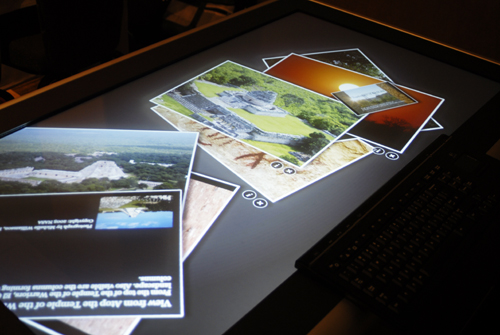
Today, whilst Seb was slaving away giving two workshops in a row at Museums and the Web 2009 I spent the day with Jim Spadaccini and Paul Lacey in a great, full-day workshop called ‘Make It Multi-touch’ that showcased the custom built 50” touch-table. You can view it over at Ideum .

We got inside information on how this technology was developed from the initial prototype back in September 2008 that featured a dual mirror and two camera solution that resulted in the need to process complicated gestures and quickly. Two prototypes later is the final product you can see here. This technology can process simple to complex gestures known as ‘blobs’ (fingers reflected) which is fed to software that can process touch, drag and drop, pinch and expand, drawing, rotate and double tap features that are all intuitive to the user within a short time-frame. The aim is to provide an interactive social experience that is very different to the traditional computer based interactive exhibits that can tend to isolate the experience to one visitor.

_dsc01092

What can we learn from the public about using museum collections and content through technology such as multi-touch? This form of technology may be a novelty for some at this stage but the future design of this product holds potentials for change amongst many museum applications.

Scenario: Multi-touch tables are available in a museum exhibition for the public to use and interact with exhibition content. Images of collection objects can be moved across the table, details of content can be zoomed in through simple “blob” (finger) movements. Descriptive information about the object can be shown through XMP metadata stored in the file. Location data can be retrieved and the user can create their own exhibit and learning experience. This is a very different user application that can change visitor’s experiece. Do we need to compete with devices that are currently available at home and make it social and educational in the museum? Does fixed navigation work anymore?

_dsc0094

Multi touch technology has potential to change museums experience and it will be interesting to watch this technology develop. Will the public start to expect to come to museums to interact with exhibits in this new way?

This is definitely more than a “big-ass table”.

Post & photography by Paula Bray

Categories
Developer tools

Intgerating Twitter tweets into blog comments

Backtype has just released the very first 0.1 version of a WordPress plugin that integrates tweets and retweets as well as comments on other blogs into the comment stream of your original WordPress posts.

I’ve been trialling an install and you can see it in action on a post like this one. Notice that the tweets are interleaved with comments on the blog itself – it even deciphers shortened URLs. (And in case you were wondering which URL shortener is the best check out this article from Searchengineland – hat tip Chloe Sasson!)

This sort of cross-site conversation tracking is becoming increasingly important in a world where tweets are easier and more common than on-blog comments. I’ll be watching with interest to see how the plugin evolves.

A word of caution before you go and roll it out on all your blogs – consider the additional moderation that seeing every public tweet and offsite comment is going to create for you!

Categories
Mobile QR codes User experience

A quick QR code update

As regular readers know, we’ve been trialling QR codes and a little while back rolled them on a small selection of object labels in a Japanese fashion display.

I’ve been keep an eye on their usage and some of the continuing problems around lighting, shadows, and low-resolution mobile phone cameras like the current iPhone 3G. So far usage has been, as expected, low. Firstly, the target audience for the exhibition content has, not surprisingly, not been very tech-savvy. Secondly, the ‘carrot’ isn’t clear enough to cause the audience to respond to the call to action.

More critically, one thing we still haven’t quite gotten right is the image size and error correction.

Shortly after the last post we upped the error correction in the codes to 30% (meaning that up to about 30% of the image can be obscured and it still scans – although it is isn’t evenly spread). This alone wasn’t enough.

With the long URLs encoded in the codes plus the error correction the resulting QR codes were even more ‘dense’ and hard to scan with 2 megapixel cameras. We’ve now done another set of codes with our own version of TinyURLs that generate locally. This has reduced the encoded characters from nearly 70 to around 25 characters – thus a far less dense code.

Even so, 2 megapixel cameras have patchy results when obscured by lens flare or shadow so our current thinking is that in the future the codes may need to be as much as 50% bigger.

Categories
Imaging open content Web 2.0

One year in the Commons on Flickr – statistics and . . . a book!

picture-262

Today we celebrate one year in the Commons on Flickr.

Since April 8 last year we’ve uploaded 1,171 photos (382 geotagged) from four different archival photographic collections. These have been viewed 777,466 times! For photographs that had been either hidden away on our website (the original 270 Tyrrell photographs on our website were viewed around 37,000 times on our site in 2007), or not yet even catalogued and digitised this is a fantastic result. And that’s not even scratching the surface of the amazing extra information and identifications, mashups, new work and more that has come from the community participation.

To celebrate we’ve published a 78 page book!

The book was published using print-on-demand service Blurb and comes as a softcover or two different hardcovers – it is your choice! Inside there are a range of photographs alongside their individual statistics, user comments and some of the stories of discovery that have come from the first year in the Commons.

Our Photo of the Day blog is giving away 10 copies and you can buy copies for your friends over at Blurb.

I’d personally like to thank everyone at the Powerhouse who have supported our involvement in the Commons and helped make available so many photographs. I’d also like to thank the enthusiastic Flickr community who have so enthusiastically embraced these historical images; Paul Hagon for his mashup;the staff at Flickr (esp George, Dan and Aaron); and the Indicommons crew.

Without all of you this would never have happened.